


























































18 September 2026
Things you can learn on Instagram
If you follow the right people
Walt Odets review Chronoswiss Delphis
You can learn many things on Instagram if you follow the right people.
I learned about Walt Odets, and his extraordinary review of the Chronoswiss Delphis, from @crazywatches.pl.
The name meant nothing to me. Apparently, that simply means I arrived rather late to the right corner of the watch world.
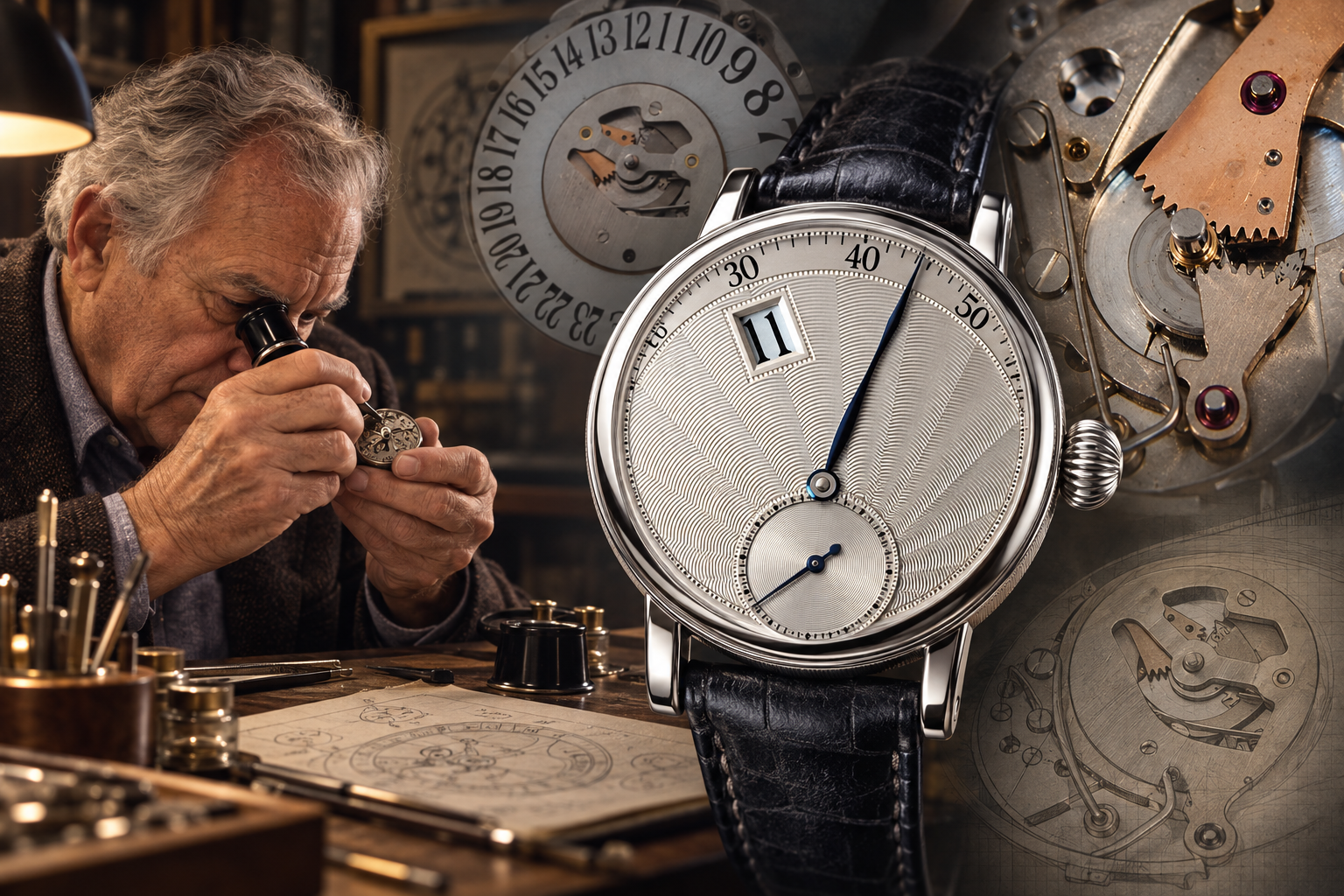
Walt Odets was one of the most important watch writers of the early internet era, although watchmaking was neither his profession nor the work for which he was best known outside our small world. He was an American clinical psychologist and author who spent much of his professional life writing about the experiences of gay men and the psychological effects of the AIDS epidemic. He was also a pilot, a photographer and a very serious amateur watchmaker.
Odets was born in 1947, the son of playwright and screenwriter Clifford Odets, and died in July 2026 at the age of 79.
For watch collectors, his legacy is a body of writing called The Horologium, published through TimeZone. Odets did something that still feels unusually honest today: he bought watches, took them apart, photographed what he found under magnification and judged the work in front of him, not the name on the dial or the story in the press release.
He examined movements from Patek Philippe, Vacheron Constantin, Audemars Piguet, A. Lange & Söhne, IWC, Omega, Rolex and others. He looked at construction, finishing, lubrication, adjustment and performance. Decorative finishing did not automatically impress him, and a famous name did not receive special protection.
His best-known article is probably his examination of the Rolex Explorer 14270. He found a robust and accurate watch, but also internal work that he considered disappointing at its price. More than twenty years later, people are still arguing about it. That tells us something about both the influence of the article and the difficulty of separating an object from the mythology surrounding its brand.
Odets was not writing the usual watch “reviews.” He was investigating the watch as a machine.
And that brings us to the subject that concerns us: jumping hours.
The Chronoswiss Delphis
In September 2002, Odets published The Chronoswiss Delphis, a detailed examination of one of the most distinctive jumping-hour watches of its period.
The correct model name is Delphis, with an “s,” although it is often shortened accidentally to Delphi.
The original Delphis combined three completely different ways of displaying time:
The hour appeared digitally through an aperture and jumped instantaneously.
The minutes were indicated by a retrograde hand travelling across an arc.
The seconds were displayed conventionally on a small subdial at six o’clock.
That mixture was part of what attracted Odets to it. He called the Delphis arguably Chronoswiss’s most interesting and original watch, and noted that its three indications each communicated time in a different way.
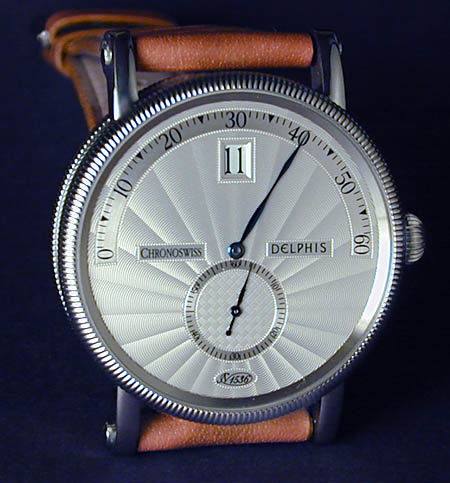
The Delphis combines a jumping-hour aperture with retrograde minutes. Photograph by Walt Odets, originally published in The Horologium.
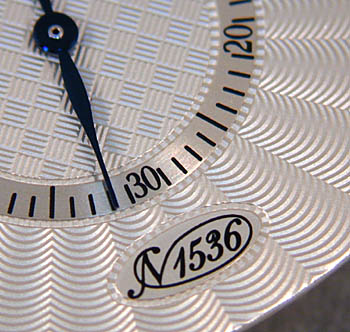
The conventional small-seconds display at six o’clock provides the third method of showing time. The oval cartouche carries the individual watch number.
The watch was also very recognisably Chronoswiss. It had the guilloché dial, onion crown and coin-edged case associated with the company under its founder, Gerd-Rüdiger Lang. But the real interest was hidden under the dial.
From Enicar to Chronoswiss
The Delphis used the Chronoswiss calibre C.124. Underneath the complication, its foundation was the automatic Chronoswiss C.122, which derived from the Enicar calibre 165 introduced in 1967.
Chronoswiss did considerably more than place its name on an old Enicar movement. Odets found better upper-plate finishing and several technical alterations. One clear example was the conversion of Enicar’s original bidirectional automatic winding system to unidirectional winding.
The visible movement, therefore, was attractive and carefully presented. The complication underneath the dial was a different matter: less beautifully finished, but much more interesting mechanically.
The large 24-hour ring
One of Odets’s photographs shows the complete hour ring surrounding the mechanism. It is the image that first caught my attention.
The ring is numbered from 1 to 23, with the Chronoswiss logo occupying the midnight position. In other words, this was a true 24-hour jumping display rather than a 12-hour disc repeating the same cycle twice per day.
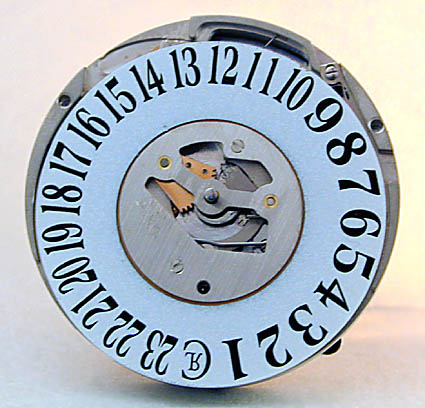
The complete 24-hour ring fitted above the movement. The Chronoswiss emblem occupies the position corresponding to midnight.
It is also a useful reminder that the numeral seen through a small window may belong to a surprisingly large component. On the wrist, the owner sees only a single hour. Underneath the dial, an entire numbered ring surrounds the movement.
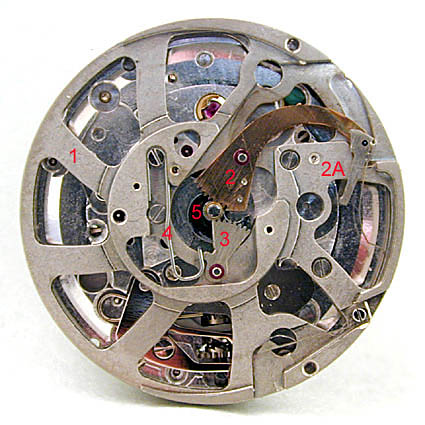
With the central cover and hour ring removed, the jumping-hour and retrograde mechanism becomes visible. Odets identified the principal components directly on the photograph. For someone thinking about the architecture of a jumping-hour watch, these photographs are more instructive than many polished movement renders. They show the real relationship between the movement, the complication and the display.
A very clever mechanism
What impressed Odets was the simplicity of the system. The jumping hour and retrograde minute display were not two unrelated complications stacked on top of one another. They were coordinated parts of the same mechanism.
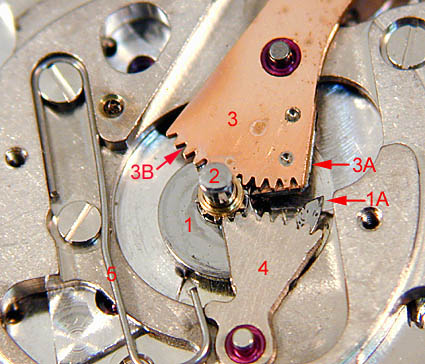
The central mechanism: snail cam (1), minute-hand pinion (2), jumping-hour lever and rack (3 and 3B), spring lever (4) and retrograde spring (5).
A snail cam is driven continuously by the movement. Its outer edge acts against a plate attached to the jumping-hour lever. As the cam turns, a rack on that lever rotates the minute-hand pinion. The pinion moves the minute hand progressively across its scale while also acting on another rack that compresses the retrograde spring.
For most of the hour, everything happens slowly. The minute hand advances, the spring stores energy and the pawl connected to the hour lever slides across the teeth or notches beneath the hour ring.
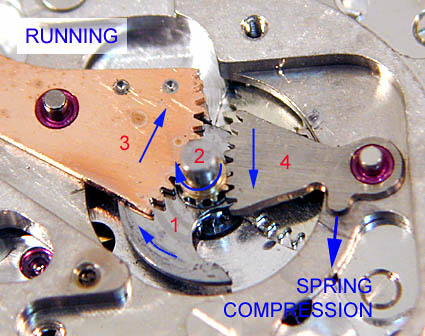
During normal running, the minute-hand pinion turns clockwise while the retrograde spring is progressively compressed.
At the end of the hour, the trailing edge of the snail cam releases the lever.
The stored energy is released immediately. The minute-hand pinion rotates backwards and returns the minute hand to zero. At the same moment, the hour lever moves in the opposite direction and its pawl pushes the hour ring forward by one position. A separate jumper spring indexes the ring and holds the new hour correctly in the aperture.
One release creates both events: the retrograde return of the minutes and the instantaneous jump of the hour.
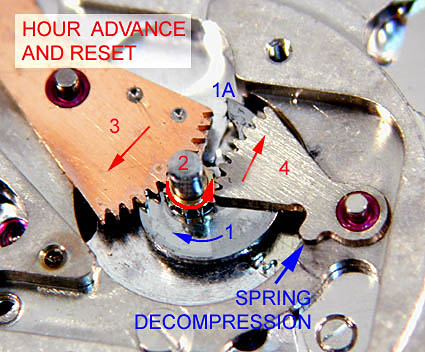
The release phase: the spring decompresses, the minute pinion reverses, the minute hand returns to zero and the hour ring advances.
It is a simple and intelligent solution. It is also an excellent example of why “simple” in watchmaking does not necessarily mean easy.
Where Odets found the weakness
This is where the article becomes more than an explanation of a clever mechanism.
Odets discovered that the hour change in the watch he examined was occasionally unreliable. The correct operation of the advancing pawl depended on a very precise adjustment of a small spring. He eventually reshaped the tip of the pawl and carefully adjusted the spring before the hour ring advanced dependably. Ain't this something we all suffer from with our jumping hour watches?
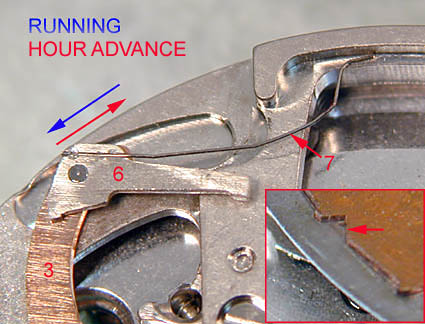
The hour-advancing pawl (6) and its tensioning spring (7). Odets found that reliable advancement depended on the precise adjustment of this small spring and the shape of the pawl tip.
That is a significant observation.
The Delphis did not fail because the basic idea was foolish or excessively complicated. On the contrary, Odets considered the design remarkably simple and clever. The weakness was concentrated in the relationship between a pawl, its spring and the teeth beneath the hour ring. A very small component and a very small adjustment determined whether the principal complication worked every time.
He also criticised the minimal finishing of the hidden complication plate and its operating parts. This was not primarily an aesthetic complaint. Odets distinguished between decorative finishing and functional finishing, and he would have preferred more attention in the mechanism itself, not merely on the parts visible through the caseback.
His photographs also documented substantial molybdenum grease on the high-load surface of the snail cam. This is particularly relevant today because, according to the watchmaker whose post led me to Odets, Chronoswiss did not issue a detailed service bulletin explaining exactly where and how the mechanism should be lubricated. A good technical teardown may therefore preserve practical knowledge that the manufacturer did not make easily available.
Odets’s verdict
Odets’s final assessment was balanced.
He admired the 38 mm case, the dial, the originality of the display and the value the watch offered compared with other mechanical complications. At the time, he believed the Delphis had no real competitor offering this kind of mechanism at anything close to its price.
But he did not confuse originality with perfection. He wanted better functional finishing beneath the dial and a more reliable method of controlling the tension on the jumping-hour pawl.
He described the Delphis as “a decent execution of a novel idea that speaks to many horological traditions.” That is not the exaggerated language normally associated with a watch review, but it is meaningful praise coming from him.
Why this old article still matters
The review was published in 2002, but it feels especially relevant now.
Today we are surrounded by excellent watch photography and beautifully produced launch material. What remains rare is an independent writer purchasing or obtaining a watch, dismantling it completely, understanding how it works and showing both the clever solution and the weak point.
For those of us interested in jumping hours, the article also contains a valuable lesson. The drama occurs once every sixty minutes, but reliability is created through thousands of small, repetitive interactions between the cam, lever, spring, pawl, jumper and hour ring.
A prototype that jumps correctly a few times is not necessarily a successful mechanism. It must continue to jump correctly as lubrication migrates, tolerances accumulate, the mainspring delivers different levels of torque and the components begin to wear.
That may be the most important thing I learned from Walt Odets: the interesting question is not only whether a mechanism works, but how it works, where it is vulnerable and whether the execution is worthy of the idea.
I came across his name by chance, through an Instagram post about servicing an old Chronoswiss. I ended up discovering one of the most important technical watch writers of the internet era, and one of the best examinations ever written about a jumping-hour mechanism.
Not bad for a morning on Instagram.
Sources and further reading
Walt Odets, The Chronoswiss Delphis, TimeZone, 16 September 2002.
The Walt Odets Archive, a curated guide to Odets’s technical watch writing.
Jack Forster, Walt Odets Made Me Do It, a personal account of Odets’s influence on watch journalism.
Walt Odets on His Five Favorite Watches, Beyond the Dial, 8 November 2022.
Walt Odets, official website and information about his work as a psychologist and author.
@crazywatches.pl, whose post led me to the Delphis article.
Older comments
 Guy NevoAuthor
Welcome to the discussion. I'd love to hear your thoughts on this piece — share your perspective below.
18 September 2026